◆Five pages print a percentage; none print the words it was measured on
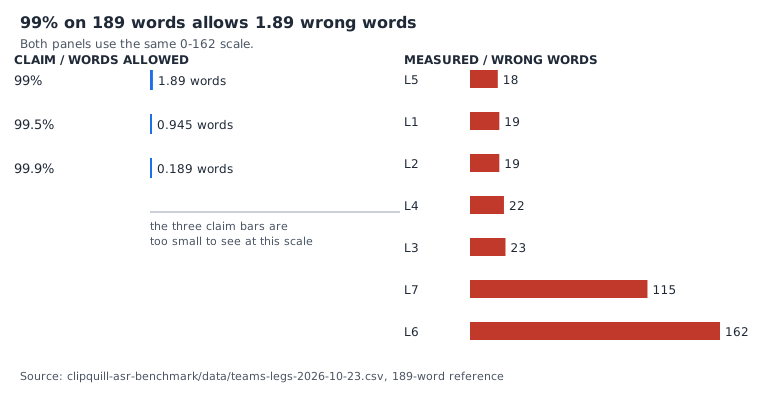
◆A percentage without a divisor is not an accuracy measurement. Take the fixed 189-word reference passage used across this site's measurements. On that passage, 99% permits 1.89 wrong words, 99.5% permits 0.945 and 99.9% permits 0.189. For a record where one word or one punctuation mark is supposed to settle the meaning, "99%" is not a rounding error away from perfect: it allows almost two words of the record to be wrong.
◆Our cleanest chain through that same passage returned 19 wrong words, a 10.05% word error rate and 89.95% of the reference words right — 10.05 times the number a 99% claim allows. We are not claiming our tool is worse than a human service: the material, the reference and the conditions are different. The point is that one of these two numbers can be recomputed and the other cannot.
- ◆99% of 189 words → 1.89 wrong words allowed.
- ◆99.5% → 0.945; 99.9% → 0.189.
- ◆Cleanest measured chain → 19 wrong / 10.05% WER, with the input and the reference published.
- ◇Of the 16 pages we could read, 5 print a numeric accuracy figure and 0 print a word count behind it.
◆Seven ways into the same 189 words: 18 to 162 wrong
One source recording, seven processing chains, one variable changed each time, all scored against the same 189-word reference. Wrong words are substitutions plus deletions plus insertions computed by a separate alignment script. The wall-clock column is one observation per chain on this machine; L1 is the cold run and carries the one-time 63 MiB model download, which is why it is the slowest row despite being the simplest chain.
| chain | what changed | wrong / 189 | WER | seconds here |
|---|---|---|---|---|
| L1 | the same room, source decoded to PCM and nothing else | 19 = 10.05% | 10.05% | 310.6 (cold) |
| L2 | the same room after a wideband meeting client's compression | 19 = 10.05% | 10.05% | 163.0 |
| L3 | the same voice arriving on a dial-in telephone leg | 23 = 12.17% | 12.17% | 81.8 |
| L4 | a phone on speaker: pink noise floor added, then a 6:1 compressor | 22 = 11.64% | 11.64% | 174.8 |
| L5 | the same room 20 dB down - a far-field or muted-speaker leg | 18 = 9.52% | 9.52% | 63.3 |
| L6 | two people talking at once, one per channel, kept separate | 162 = 85.71% | 85.71% | 63.8 |
| L7 | the same two people after the platform mixes them into one track | 115 = 60.85% | 60.85% | 43.8 |
◆Two rows in that table are the same decode: L1 and L2 both returned 19 wrong words, and L5 returned 18, one word fewer. A one- or two-word gap is inside the run-to-run band this recogniser has produced before on identical input, so we do not treat those three as different. The rows that are outside the band are L3 (23), L6 (162) and L7 (115), and each of those has one named change attached to it.
◆A second speaker costs 24.0 to 35.75 times what a telephone leg costs
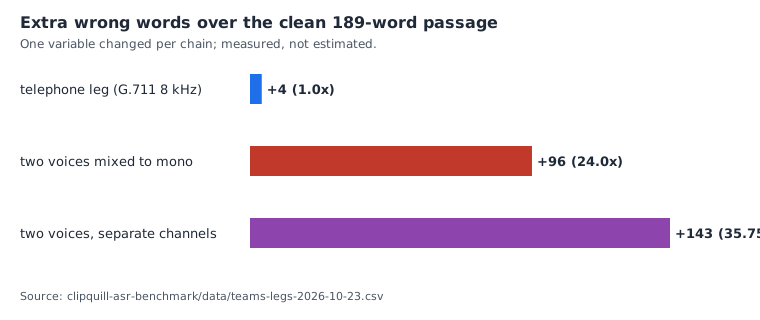
◆Subtract the clean chain from each of the three that moved. The dial-in telephone leg — G.711 at 8 kHz, then MP3 — added 4 wrong words. The same two people mixed into one mono track added 96. The same two people kept on separate channels, which this page sums before recognition, added 143. That is 24.0× and 35.75× the telephone-leg cost, and 6.05× and 8.53× the clean chain's WER.
◇That ordering matters for this phrase specifically. 12 of the 16 pages we could read talk about verbatim capture or a single word or punctuation mark deciding the record — one of them titles that section "One Word or Punctuation Mark Matters" — and 3 mention speaker identification. 5 mention timestamps or page:line numbering. 0 of the 16 name a sample rate, a bitrate, a codec or narrowband audio, and 0 give a count of words behind any accuracy figure. So the two things our single-variable table can price — a second voice and a narrowband leg — are the two things the 16 pages we could read discuss without numbers.
These are seven runs of one passage on one day. We publish them as a reproducible comparison of chains, not as a prediction for any particular deposition recording.
◆Five minutes of waiting cost zero words and 32.8 seconds of clock
Deposition recordings are not continuous speech: there are pauses, room changes, and sometimes a dial-in with hold music. We built one call five ways, from 72.454 seconds of content only up to 372.454 seconds with 240 seconds of hold music and 60 seconds of ringback in front of it.
| version | audio seconds | wrong / 189 | WER | seconds here |
|---|---|---|---|---|
| P1 — content only, 72.454 s | 72.454 | 20 = 10.58% | 10.58% | 53.4 |
| P2 — plus 30 s of hold music | 102.454 | 20 = 10.58% | 10.58% | 37.8 |
| P3 — plus 60 s of hold music | 132.454 | 20 = 10.58% | 10.58% | 44.9 |
| P4 — plus 120 s hold + 30 s ringback | 222.454 | 20 = 10.58% | 10.58% | 65 |
| P5 — plus 240 s hold + 60 s ringback | 372.454 | 20 = 10.58% | 10.58% | 86.2 |
◆All five returned 20 wrong words out of 189 (10.58%), and four of the five transcripts were byte-identical, SHA-256 prefix 3c6ff85d409fffca. Waiting is free in words and paid for in clock: the longest file is 5.141× the audio, took 86.2 seconds here against 53.4, and that is 1.614× the wall time, not 5.141×. Put the other way round, 44.22 seconds per audio minute against 13.89, a 3.18× difference in how the same words occupy the clock.
◆Three other runs in that CSV differ by one or two words (21 or 22 against 20). Those are inside the band we do not report as an effect. The longest of these rows is also the one that makes a caution worth printing: any claim of the form "transcribes an hour in N minutes" has to say whether the hour is speech or a clock, and whether the run paid for the model download.
◇What the 16 pages we could read actually print
◇3 searches on 2026-11-09 — deposition transcription, deposition transcription services, transcribe a deposition — returned 30 result slots across 15 hosts and 20 distinct URLs after deduplication. Two hosts answered HTTP 403 to every user-agent layer we tried and one result carried only 55 characters of body text, so 16 pages were read for this count. Every fraction below is out of those 16. The pages were read, not run: we did not give any of them our seven files.
| what a page could print | pages that do | what we found |
|---|---|---|
| prints a numeric accuracy percentage | 5 of 16 | 99% (Rev, GMR Transcription, SpeakWrite), 99.5% (360 Transcription), 99.9% (Rev). A sixth page prints "100% human transcription", which is a staffing figure, not a word-accuracy figure |
| ◆gives a denominator: word count, reference, test set or WER | 0 of 16 | none of the 16 states how many words any percentage was measured on, or what it was compared against |
| ◆names a sample rate, bitrate, codec or narrowband audio | 0 of 16 | the audio the percentage applies to is not specified on any of the 16 pages we could read |
| talks about verbatim capture, one word or a punctuation mark | 12 of 16 | Esquire Solutions: "One Word or Punctuation Mark Matters"; SpeakWrite: "Verbatim captures every word spoken" |
| mentions timestamps or page:line numbering | 5 of 16 | Rev's "100% page:line accuracy" is a summary format claim, not a word count |
| mentions speaker identification | 3 of 16 | none of the three prints what happens to words when two people speak at once |
◇The two zero rows are the gap this page answers. 5 pages quote a percentage and 12 argue that a single word or punctuation mark can change the record, yet 0 of the 16 pages we could read prints the divisor that would let a reader turn one of those percentages into a number of words. We printed ours: 189 words, 19 wrong on the clean chain, and the alignment method underneath the count.
Questions this page answers
What does 99% accurate mean for a deposition transcript?
Without a word count it cannot be checked. On our fixed 189-word reference passage, 99% allows 1.89 wrong words, 99.5% allows 0.945 and 99.9% allows 0.189. A verbatim record is not 'nearly perfect' at 99%; it permits almost two words of the record to be wrong. Of the 16 pages we could read ranking for deposition transcription, 5 print a numeric accuracy figure and 0 print the number of words it was measured on.
How many wrong words did a real recording produce?
The cleanest of seven chains through the same 189-word passage came back with 19 wrong words, a 10.05% word error rate and 89.95% of the reference words right. That is 10.05 times the 1.89 words a 99% claim allows. The seven chains were built from one source recording with one variable changed each time, so the differences are attributable to the chain and not to a different speaker or script.
Does a second speaker hurt more than a telephone line?
On our material, by more than an order of magnitude. A dial-in telephone leg (G.711 at 8 kHz, then MP3) added 4 wrong words over the clean chain. The same two people mixed into one track added 96, and kept on separate channels added 143. That is 24.0 times and 35.75 times the telephone-leg cost. We report this as a result on one passage, not as a law about depositions.
Do pauses and waiting time in a recording change the words?
Not in our runs. Five versions of one call with 0, 30, 60, 150 and 300 seconds of hold music and ringback all returned 20 wrong words out of 189 (10.58%), and four of the five transcripts were byte-identical. What waiting changes is the clock: the longest file is 5.141 times the audio and took 86.2 seconds here against 53.4 for the shortest. The two runs that differ by one or two words sit inside the run-to-run band we do not treat as an effect.
What sample rate or codec should a deposition recording use?
Of the 16 ranking pages we could read, 0 name a sample rate, a bitrate, a codec or narrowband audio at all, so the pages quoting a percentage do not say what audio it applies to. In our separate eight-clip benchmark the 8 kHz mono MP3 returned 113 of 133 words right against 119 for a 44.1 kHz mono MP3 at the same bitrate, 6 words apart, with the two files only 610 bytes apart. Bandwidth, not file size, was the difference.
Can I transcribe a deposition without uploading the recording?
Yes. The file is opened in the tab, decoded there and handed to a recogniser running in the same tab; zero bytes leave the device. There is no account, no minute allowance and no per-file limit on this page. The tool does not fetch a recording from a link and it will not decode a stream the browser cannot read, so check that the file plays locally first.
How is word error rate different from the accuracy percentage a vendor quotes?
Word error rate has a divisor: substitutions plus deletions plus insertions, divided by the words in a stated reference. On our 189-word passage the clean chain had 19 wrong words and therefore a 10.05% WER. A vendor's 99% is the complement of a number whose reference, test set and alignment are not printed on any of the 16 pages we could read. Across our eight-clip benchmark the base model ran at 20.1% WER on 229 reference words, about 46 wrong words.
Where can I reproduce these numbers?
Every figure on this page is recomputed from the CSV files in the open clipquill-asr-benchmark dataset: teams-legs-2026-10-23.csv for the seven chains, call-parts-2026-10-24.csv for waiting time, wer-by-sample.csv and wer-by-condition.csv for the eight-clip totals, and mp3-delivery-2026-11-08.csv for the 8 kHz comparison. The repository, the dataset mirror and the archived DOI are linked from the organisation block on this site.
Where these numbers come from, and where they stop
- ◆The reference. One fixed 189-word passage, used across this site's chain measurements, scored by a separate alignment script. Wrong words = substitutions + deletions + insertions. In the eight-delivery MP3 set one build broke down as 14 substitutions, 1 deletion and 3 insertions = 18 wrong, 118 of 133 right (88.72%).
- ◆The chains.
teams-legs-2026-10-23.csv— seven builds of one source, from PCM in the same room to two people on separate channels.call-parts-2026-10-24.csv— nine builds of one call with waiting and container changes. - ◆The wider benchmark.
wer-by-sample.csvandwer-by-condition.csv: 8 clips, 229 reference words, 20.1% base WER overall, about 46 wrong words, one wrong word every 2.015 seconds of audio. The worst single clip ran 40.8% and the smallest was 11 words at 18.2%. - ◆The bandwidth check.
mp3-delivery-2026-11-08.csv: an 8 kHz mono MP3 returned 113 of 133 words right against 119 for a 44.1 kHz mono MP3 at the same 32 kbit/s, 6 words apart, with the two files 610 bytes apart. - ◇The 16 pages. Read on 2026-11-09 from 20 distinct URLs across 15 hosts. Counts come from a term scan with the matching lines printed and checked; a page counts once per URL, not once per mention.
- ◆What this does not cover. No legal vocabulary list, no multi-hour deposition, no comparison against a certified court reporter, no human proofreading pass, and no errata sheet. The 16 ranking pages were not given these files. Every chain was run once, and the one- and two-word differences in the tables are reported as noise, not as results.
- ◆Where to get the inputs. The CSV files, the ffmpeg commands and the source audio are in the open clipquill-asr-benchmark repository, mirrored as a Hugging Face dataset and archived with a Zenodo DOI, all linked from the organisation block on this site.